The Austin Club
Leadership Blog
February
Why Stewardship Matters — Today and for the Next 100 Years
 February 2026 Monthly Column – #1
From the Desk of Paul Kornfeind, MCM
Stewardship at The Austin Club
Why Stewardship Matters — Today and for the Next 100 Years
Leadership, at its core, is not about ownership — it is about stewardship.
Every day at The Austin Club, I am reminded that we are temporary caretakers of something far larger than ourselves. A historic institution. A place of gathering and belonging. A community shaped by generations of members, leaders, and staff who came before us. The decisions we make today will quietly shape experiences long after we are gone.
That responsibility is not lost on me.
The Austin Club is more than a venue or a dining room. It is a living institution housed within the historic Millett Opera House — a structure that has stood at the center of Austin’s civic and cultural life for well over a century. Preserving that legacy while ensuring relevance for future generations requires intentional leadership, thoughtful planning, and a deep respect for tradition balanced with modern hospitality.
Stewardship means asking different questions.
Not simply, “Does this work today?”
But rather, “Will this still matter tomorrow — and decades from now?”
It means investing in people, culture, and systems that allow excellence to endure. It means understanding that hospitality is not transactional; it is relational. It is built on trust, consistency, and genuine care — for members, guests, staff, and the community we serve.
This philosophy extends beyond the Club itself to the work of the Millett Opera House Foundation. Preservation is not a short-term effort. It requires long-range vision, disciplined stewardship, and a belief that historic places matter — not as relics of the past, but as active contributors to our shared future.
Stewardship also shows up in quieter moments. In mentoring a young professional. In empowering a team member to lead with confidence. In making decisions that may not be the easiest in the moment, but are the right ones for the long term. These moments rarely make headlines, yet they form the foundation of lasting success.
This column will serve as a place to share reflections on leadership, hospitality, preservation, and the moments — both visible and unseen — that define our journey at The Austin Club. It is an opportunity to document not just what we do, but why we do it.
We are entrusted with something special here. My goal is simple: to ensure that when future generations walk through these doors, they feel the same sense of pride, belonging, and purpose that has defined The Austin Club for more than 130 years.
That is the work of stewardship.
And it matters — today, and for the next 100 years.
— Paul Kornfeind, MCM
General Manager, The Austin Club
March
Timeless Traditions, Modern Hospitality — What That Promise Really Means
 From the Desk of Paul Kornfeind, MCM
Stewardship at The Austin Club
Timeless Traditions, Modern Hospitality — What That Promise Really Means
Every institution that endures over time carries with it a quiet responsibility: the responsibility to honor its traditions while remaining relevant to the world around it.
At The Austin Club, we often speak about Timeless Traditions, Modern Hospitality. It is a phrase that captures our philosophy, but it is more than a tagline. It is a guiding principle that shapes the way we think, the way we serve, and the way we plan for the future.
Tradition provides the foundation. It reminds us who we are and where we came from. The Austin Club has been part of the fabric of this city for more than a century, and the historic Millett Opera House stands as a physical reminder of that legacy. Within its walls, generations have gathered for meaningful conversations, celebrations, and civic engagement.
These traditions matter. They create continuity, character, and a sense of belonging that cannot be manufactured overnight.
But tradition alone is not enough.
Hospitality, at its best, is a living practice. It evolves with the needs of the people we serve. Modern hospitality requires attentiveness, adaptability, and an understanding that expectations change over time. Members today value both excellence and authenticity. They appreciate history, but they also expect service that feels current, thoughtful, and personal.
Balancing these two forces — tradition and progress — is one of the most important responsibilities of leadership.
In practical terms, this balance appears in many ways. It shows up in the way we care for the historic Millett Opera House while making thoughtful improvements that ensure its continued vitality. It appears in the way our team embraces professional standards of service while bringing warmth and genuine personality to every interaction. And it appears in the way we introduce new experiences and programming while respecting the character that makes The Austin Club unique.
This balance is rarely achieved through grand gestures. More often, it is built through small, thoughtful decisions made consistently over time.
It is also made possible by the people who bring the Club to life each day — the staff who serve with pride, the members who engage with enthusiasm, and the leaders who approach their roles with a sense of stewardship rather than ownership.
When these elements come together, something special happens. Tradition is preserved, but it does not feel frozen in time. Hospitality feels refined yet welcoming. The past is honored, and the future remains open with possibility.
That is what Timeless Traditions, Modern Hospitality truly means.
It is not simply a phrase. It is a promise — one that guides our work today and helps ensure that The Austin Club continues to thrive for generations to come.
— Paul Kornfeind, MCM
General Manager, The Austin Club
April
Leadership, Innovation, and the Future of Private Clubs

From the Desk of Paul Kornfeind, MCM
Stewardship at The Austin Club
Reflections from the Road: Leadership, Innovation, and the Future of Private Clubs
Last week, I stepped away from the Club and into a room with more than 95 fellow club leaders and industry partners at The Houstonian in Houston.
There is something powerful about being in a room with people who understand the pace, the pressure, and the responsibility we carry every day. The conversations were honest, direct, and grounded in real experience. And one thing became very clear—our industry is not standing still. The future of private clubs is not something off in the distance. It is being shaped right now by how we lead, how we adapt, and how clearly we understand who we are.
Leadership came up again and again—but not in theory. In practice.
Leadership is not about title; it is about presence. It is how we show up when things are going well, and how we respond when they are not. Our teams are always watching, and over time those daily moments define the culture of our clubs. The clubs that will thrive in the future will not be the ones with the most resources—they will be the ones with the strongest cultures, built through consistent leadership, clear expectations, and a genuine commitment to people.
We also spent time on innovation, technology, and AI—topics that are quickly becoming part of everyday operations.
The opportunity is real. These tools can improve communication, drive efficiency, and support better decision-making. But innovation must be intentional. It should never replace what makes a club special—it should strengthen it. At The Austin Club, we often say Timeless Traditions. Modern Hospitality. That balance matters. The future will not be defined by who adopts the most technology, but by who uses it to enhance the member experience without losing their identity.
Perhaps the most important takeaway was a simple question: What will your legacy be?
That question sits at the heart of what we do. We are not just managing operations—we are serving as stewards of institutions meant to last. The future of private clubs will be shaped by leaders who can honor tradition while embracing change, who invest in their people, and who build with intention. The conversations will evolve and the tools will change, but the responsibility remains the same—to lead with purpose, protect the culture, and leave something stronger behind.
Honor the past, lead in the present, build for the future—the work continues.
— Paul Kornfeind, MCM
General Manager, The Austin Club
May
Holding the Line While Building the Future
From the Desk of Paul Kornfeind, MCM
Stewardship at The Austin Club
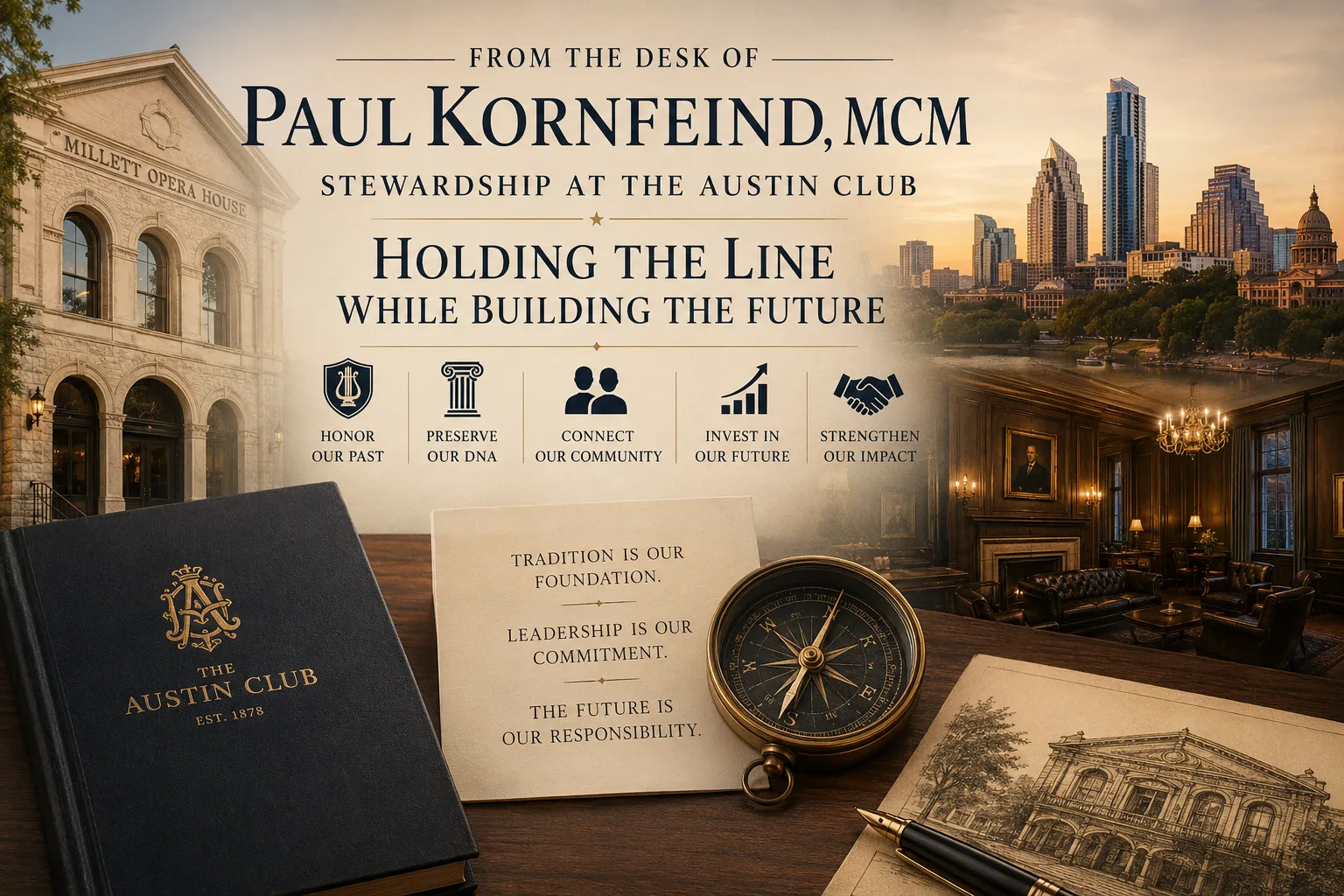
Holding the Line While Building the Future
My first instinct when thinking about the future of The Austin Club is simple:
Stay true to who we are.
Not reactive. Not trend-driven. Not chasing what others are doing.
Instead, grounded in our identity — and thoughtful in how we evolve.
Every enduring institution has a defining character — a kind of internal rhythm that guides its decisions, shapes its culture, and ultimately determines whether it stands the test of time.
At The Austin Club, that rhythm begins with something fundamental: we must hold onto our original DNA while continuing to build for the future.
The Millett Opera House was not created by accident. Charles Millett’s vision established more than a building — it established a standard. A place where people gathered with purpose, where hospitality mattered, and where community was cultivated with intention. That foundation still exists today, and it is our responsibility to protect it.
Stewardship, in its truest form, is not about reinvention. It is about preservation with purpose — ensuring that what made this place special continues to define it, even as we grow.
In many ways, I think of it like music.
Every great composition begins with a bass line — steady, consistent, and foundational. It is not always the loudest part of the piece, but without it, everything else loses structure. At The Austin Club, our traditions, our values, and our commitment to hospitality form that bass line. They must remain steady, even as everything around them evolves.
From that foundation, we build.
We introduce programming designed to bring members together in meaningful ways. The return of the 1878 Social Hour is one example — a nod to our history, reintroduced in a way that feels relevant and engaging for today’s membership. It is familiar, yet refreshed. Traditional, yet alive.
At the same time, stewardship requires us to make thoughtful investments in the future. Strengthening our systems, improving our operational infrastructure, and embracing tools such as remote membership development are not departures from who we are — they are necessary steps to ensure we remain strong and sustainable for the next generation.
Every decision we make must pass a simple test:
Does it honor our past?
And does it position us for the future?
That mindset extends beyond the walls of the Club.
We are part of a broader business and civic ecosystem here in Austin. Stewardship means engaging with that ecosystem — supporting it, contributing to it, and finding ways to give back to the community that surrounds us. A strong institution does not stand alone; it thrives through connection.
When these elements come together — tradition, thoughtful innovation, community engagement, and disciplined leadership — something powerful happens. The Club does not lose its identity as it evolves. It strengthens it.
That is the balance we strive for every day.
Hold the line where it matters most.
Build where it matters next.
That is how we honor the vision we inherited — and ensure it continues to serve those who will follow.
— Paul Kornfeind, MCM, CCE, CCM
General Manager, The Austin Club
June
The Long Shot

From the Desk of Paul Kornfeind, MCM
The Long Shot
A few weeks ago, an Austin Club member suggested I watch a movie called The Long Shot.
Knowing my appreciation for golf, history, and all things Austin, I gladly accepted the recommendation. I settled in one evening expecting a good golf story. What I did not expect was to spend the next two hours thinking about The Austin Club, the Historic Millett Opera House, and my grandson Sebastian.
The film tells the story of Austin's beloved Lions Municipal Golf Course, affectionately known as "Muny" to generations of Austinites. At its heart, however, the movie is not really about golf. It is about a community coming together to preserve a place that matters. It is about protecting a piece of Austin's identity in the face of tremendous change.
As I watched, I found myself reflecting on the places that become woven into the fabric of a city. Places where friendships are formed, traditions are passed from one generation to the next, and memories are created that last a lifetime. Places that become much more than buildings, golf courses, or gathering spaces. Places that become part of a community's story.
For nearly 150 years, the Historic Millett Opera House has been one of those places.
Long before Austin became one of the fastest-growing cities in America, the Millett was already bringing people together. Governors, legislators, business leaders, entrepreneurs, artists, families, and friends have all passed through its doors. Some came to celebrate, some came to debate, and some simply came to enjoy the fellowship of others.
What they all left behind was a story.
One of the themes that resonated with me throughout The Long Shot was the idea that preservation is not about resisting change. Cities evolve. Communities grow. New generations arrive with fresh ideas, different perspectives, and new expectations. Preservation is about ensuring that as we move forward, we do not lose sight of the places, traditions, and values that helped shape who we are.
That thought has been on my mind quite a bit lately.
Over the past several months, I have had the privilege of spending time with members representing multiple generations of Austin families. Some have been connected to The Austin Club for decades. Others are just beginning their journey with us. What has been encouraging to see is that regardless of age, profession, or background, they share a common belief that this Club matters. Not simply because of its history or its beautiful surroundings, but because of the people, the relationships, the experiences, and the sense of belonging that have defined The Austin Club for generations.
As many of you know, one of my favorite people in the world is my grandson, Sebastian. Like most grandfathers, I probably talk about him more than I should. As I watched the movie, however, I found myself wondering what Austin will look like when Sebastian is my age.
Will places like Muny still be there? Will he have the opportunity to walk through the Millett Opera House and appreciate the generations of history that came before him? Will he understand why people cared enough to preserve these treasures for future generations? I certainly hope so.
Because stewardship is not really about buildings. It is not about golf courses, organizations, or even historic landmarks. Stewardship is about people. It is about preserving experiences, relationships, traditions, and a sense of community that is worth passing on. Every generation inherits something special. The true measure of stewardship is whether we have the wisdom, vision, and commitment to leave it better than we found it. That is true for a golf course, it is true for a historic opera house, and it is certainly true for The Austin Club.
The Long Shot turned out to be far more than a golf movie. It was a powerful reminder that some things are worth preserving—not because they belong to us, but because we are merely their caretakers for a brief moment in time, and that is a responsibility worth embracing.
— Paul Kornfeind, MCM, CCE, CCM
General Manager, The Austin Club
The Austin Club
July
From Mentee to Mentor
Last week, I lost my last living mentor.
The news hit me harder than I expected. While I knew he had lived a full life and left behind an extraordinary legacy, his passing marked the end of a chapter in my own life as well. It caused me to pause and reflect not only on the man he was, but on the profound impact mentors have on the people they guide.
As I thought back to my early years in the private club industry, I found myself smiling at memories from more than thirty years ago. I was a young Assistant General Manager, eager to learn, eager to prove myself, and convinced that success would come from mastering budgets, operations, food and beverage, and membership development.
What I didn't understand at the time was that some of the most important lessons I would ever learn would not come from a textbook, a seminar, or a certification program. They would come from watching experienced leaders navigate challenges, build relationships, make difficult decisions, and carry themselves with professionalism and grace.
The older I get, the more I appreciate that every successful career is built upon the generosity of those who came before us. None of us arrive where we are alone. Along the way, someone opens a door, offers encouragement, shares wisdom, provides guidance, or simply demonstrates what excellence looks like through their daily actions.
As I reflected on the life of my mentor, I found myself thinking about the incredible journey that takes place over the course of a professional lifetime. At some point, we are all mentees.
I remember being a young Assistant General Manager in the early 1990s, trying to learn everything I could about the private club business. Like most young managers, I thought I needed to learn budgets, operations, food and beverage, membership, and leadership.
What I didn't realize at the time was that I was also learning from the people around me.
I watched how successful leaders carried themselves. I watched how they handled pressure, interacted with members, managed employees, and made difficult decisions. Some lessons were taught intentionally. Others were learned simply by paying attention.
Looking back, many of the things I still practice today were learned more than thirty years ago from mentors who took the time to invest in a young manager with a lot to learn.
As the years passed, something interesting happened.
Without even realizing it, I slowly transitioned from being the mentee to becoming the mentor.
One day you find yourself answering the same questions you once asked. You hear yourself sharing advice that was given to you years earlier. You watch young professionals struggle with the same challenges you faced early in your career, and you find yourself wanting to help them succeed.
That is when you realize mentorship is not a destination. It is a relay race.
Someone hands the baton to you. You carry it for a while. Then it becomes your responsibility to pass it to the next generation.
Today, nearly four decades into my career, I am grateful for every mentor who invested in me. Their lessons helped shape the leader I became. Just as importantly, they taught me the responsibility that comes with experience.
Find a mentor.
Listen carefully.
Learn everything you can.
Then, when your time comes, become one.
Because the greatest legacy any leader leaves behind is not found in a title, a building, or a résumé.
It is found in the people they helped along the way.
August
My Biggest Challenge is Not What You Might Think
 August 2026 Leadership Blog
During a recent lunch, I was asked a question that caused me to sit back in my chair and think.
The question came from Bianca Pisa, the Assistant Food and Beverage Manager at the University of Texas Golf Club. Bianca is a talented young professional who recently joined the Club Management Association of America, and I have had the privilege of beginning what I hope will become a meaningful mentorship relationship with her.
As we talked about leadership, hospitality, and the opportunities ahead of her, Bianca asked me, “What is the biggest challenge in your job?”
It was an excellent question. In fact, it was the kind of question that reminds us why mentorship is never a one-way relationship. Sometimes the person we are mentoring asks the very question we need to ask ourselves. The answer depends upon which hat I am wearing.
When I Am Wearing My General Manager Hat
As General Manager of The Austin Club, my greatest challenge is member engagement.
It is finding meaningful ways to help our members become more involved, more connected, and more passionate about their Club. It is encouraging them to join a committee or council, support a social event, invite a prospective member, attend a cultural program, or simply come downtown and enjoy dinner with people they might not otherwise have had the opportunity to know.
A club can create beautiful events, serve wonderful meals, and offer an extraordinary setting, but the true strength of any private club will always be found in the relationships among its members. The Austin Club becomes stronger every time a member walks through our doors, extends a hand, begins a conversation, or chooses to become part of something.
Engagement cannot be measured only by attendance numbers or dining revenue. It is measured by whether our members feel that they belong, whether they understand that their presence matters, and whether they recognize that this is not merely the Club they belong to—it is their Club.
That sense of ownership is what transforms membership into community.
When I Am Wearing My Stewardship Hat
When I am wearing my hat as a steward of the Millett Opera House Foundation, the answer becomes more complex.
Yes, preserving and protecting a 148-year-old historic building is an enormous challenge. Historic structures require constant attention, thoughtful planning, specialized expertise, and significant financial resources. Every roof, window, wall, staircase, and architectural detail carries both a responsibility and a story. Yet the physical preservation of the historic Millett Opera House is not our greatest challenge.
Our greatest challenge is helping people think generationally.
It is helping our members look beyond the needs of today and imagine what this remarkable place can mean fifty or one hundred years from now. It is inviting them to fall in love with the history of the Millett Opera House and to understand that we have inherited far more than a building. We have inherited a responsibility that began with Captain Charles Millett and has been carried forward by every generation that refused to allow this place—and everything it represents—to disappear.
Captain Millett could not have known the names of the people who would gather beneath this roof nearly a century and a half later. He could not have imagined The Austin Club, our scholarship program, our cultural initiatives, or the leaders who would one day walk these halls. He simply had a vision for what this place could become and the courage to build something that would outlive him.
Now that responsibility belongs to us.
Thinking Beyond Our Own Generation
Generational thinking asks us to consider a different set of questions.
What will we leave behind?
Will the next generation inherit a building that has merely survived, or an institution that is financially secure, culturally significant, and prepared to serve Austin for another century? Will our children and grandchildren know that we understood the importance of the moment entrusted to us?
What will we place in his hands?
That is no longer an abstract question. I think about Leonard Alden Smith—known to his family as Leo—who we just welcomed into this world and who represents the fifth generation of the Smith family connected to The Austin Club.
One day, when Leo is old enough to walk through these doors and understand the generations of his family that came before him, I want him to inherit more than stories about what the Millett Opera House once was. I want him to inherit a historic home that has been preserved, an institution that is financially secure and culturally alive, and the opportunity to carry that legacy forward as a fifth-generation leader.
He represents the next generation that will either benefit from the decisions we make today or inherit the consequences of the opportunities we allowed to pass. Our responsibility is not simply to preserve what previous generations gave us. It is to strengthen it, expand its purpose, and pass it forward with even greater promise.
Two Hats, One Challenge
The more I reflected on Bianca’s question, the more I realized that these two challenges are not as different as they initially appear.
Whether I am serving as General Manager of The Austin Club or as a steward of the Millett Opera House Foundation, the challenge is fundamentally the same: helping people understand that they are part of something larger than themselves.
- Member engagement is about belonging in the present. Stewardship is about accepting responsibility for the future.
- One invites us to take our seat at the table today. The other asks us to make certain that the table will still be here for generations yet to come.
This is why our Six Pillars matter. They provide a vision for preserving our past while thoughtfully building our future. This is why we say, “It Takes Ten Hands to Score a Basket.” No meaningful legacy is created by one person working alone. It is also why I continue to believe so strongly in the power of “Just One.”
What is the one meaningful contribution each of us can make to strengthen The Austin Club and protect the historic Millett Opera House?
For one member, it may be attending a dinner or bringing a friend to the Club. For another, it may be joining a committee, mentoring a young professional, supporting a scholarship, making an introduction, or investing in the long-term preservation of our historic home. No single act must carry the entire weight of our future, but every act can help move that future forward.
One conversation can create a relationship. One invitation can awaken a sense of belonging. One mentor can change the direction of a young leader’s life. One gift can preserve a piece of history. One member can inspire another, and one generation can leave an institution stronger than it found it.
Bianca asked me about the greatest challenge in my job. She also reminded me of its greatest privilege.
We are not simply managing a private club, maintaining an old building, or planning for another successful year. We are nurturing relationships, preserving history, building futures, and extending a vision that began in 1878 into generations we may never personally know.
That is the work before us, and that is the legacy within our reach.
Every member a steward. Every gift a legacy. Preserving history and building futures.
With gratitude,
Paul Kornfeind, MCM, CCE, CCM
General Manager
The Austin Club
September
A Historic Diamond: Vision, Action, And The Courage To Move Forward
September 2026 Leadership Blog

From the desk of Paul Kornfeind MCM
There is something extraordinary about walking into a building that has stood since 1878. The walls carry stories. The staircases have felt the footsteps of generations. The rooms have welcomed governors, legislators, business leaders, artists, performers, families, and friends. For nearly 150 years, the historic Millett Opera House has remained part of the fabric of Austin, and since 1949, it has been the proud home of The Austin Club.
It is a remarkable inheritance, but history alone does not guarantee a future.
Vision is essential to leadership because someone must be willing to see what is possible before everyone else can see it. However, vision without action eventually becomes little more than wishful thinking. At some point, we must move beyond admiring the possibilities and begin the practical work of bringing them to life.
For The Austin Club, that work begins with an honest understanding of what will drive our future. Two fundamental forces support nearly everything we hope to accomplish: membership growth and significant events. We must continue attracting people who want to belong to something meaningful, while also positioning the Club as one of Austin’s most distinctive places to gather, celebrate, conduct business, and create lasting memories.
Both depend upon the product and experience we provide.
People may initially be drawn to our history, but they will make their decisions based upon how that history feels today. They notice whether the building appears cared for, whether the spaces feel clean and welcoming, whether the kitchen can support an exceptional event, and whether the entire experience reflects the strength and significance of The Austin Club brand. They may not see every operational challenge behind the scenes, but they can certainly feel the result.
That is why our path forward must include both the practical and the refresh.
The practical work comes first because preservation begins with protection. A sound roof is not exciting or glamorous, but it protects the historic building, its furnishings, its artwork, and everything entrusted to our care. Reliable electrical systems are essential to operating safely and meeting modern demands. Updated kitchen equipment gives our culinary team the tools necessary to deliver the quality and consistency our members and guests deserve.
These improvements may never appear in a beautiful photograph, but they are among the most important investments we can make. True stewardship is often found in the work people never see.
The refresh is equally important because first impressions matter.
Before a prospective member experiences our hospitality, attends an event, or learns the remarkable story of the Millett Opera House, that individual has already formed an impression. It begins at the curb. It continues at the entrance. It is shaped by the lighting, cleanliness, finishes, signage, landscaping, and the feeling that someone has thoughtfully prepared for their arrival.
Our front entrance is important, but so is our side entrance. For many members and guests, that doorway is their first experience with The Austin Club. The Governor of Texas has entered through it, along with civic leaders, prominent guests, wedding parties, prospective members, and families arriving for some of the most meaningful celebrations of their lives. If that entrance serves as a front door for so many people, it should feel like one.
It should communicate pride, warmth, confidence, and a sense of arrival before a member of our team ever has the opportunity to say, “Welcome to The Austin Club.”
Refreshing a historic property does not mean stripping away its soul or attempting to make it something it was never intended to be. It means respecting the original character while thoughtfully improving how people experience it. It means revealing the beauty that is already there, preserving what is irreplaceable, and upgrading what is necessary to meet the expectations of today.
A diamond does not lose its history when it is polished. Its brilliance becomes visible again.
That balance is at the heart of our promise: “Timeless Traditions. Modern Hospitality.” The two ideas are not in conflict. In fact, they depend upon one another. Tradition gives us meaning, identity, and authenticity, while modern hospitality ensures that those traditions remain relevant and inviting to the next generation.
We should never modernize merely for the sake of appearing new, nor should we allow nostalgia to become an excuse for standing still. Our responsibility is to understand what must be preserved, recognize what must be improved, and have the courage to act upon both.
Progress will require patience, planning, investment, and shared commitment. Not everything can happen at once, and not every decision will be easy. However, moving forward does not begin with having every answer. It begins with agreeing that this historic diamond is worth protecting, polishing, and preparing for the future.
Leadership requires us to be grateful for what previous generations placed in our hands while remaining honest about what the next generation will need from us. We are not the owners of this legacy as much as we are its temporary stewards. The decisions we make today will determine whether those who follow us inherit only a beautiful story about what The Austin Club once was, or a thriving institution ready to begin its next great chapter.
I believe deeply in that next chapter. I believe in the power of this building, the strength of The Austin Club brand, and the extraordinary opportunity before us. Most importantly, I believe that vision, followed by thoughtful and determined action, can ensure that this historic diamond continues to shine for generations to come.
The time has come to protect what matters, refresh what needs attention, and keep moving forward.